Tuesday, 2 October 2012
Time traveling via the opera tour...keeping it in the family, part 3: Perth
When he was in his early twenties, my late husband (the father of my eldest son) worked for a time in forestry on the Duke of Atholl's estate in Perthshire, Scotland. He often cited those days as being some of the happiest of his life: he was young and healthy, he was working outdoors in the fresh air, and he felt in harmony with the world around him. One day while up in the hills clearing bracken and planting pine saplings, he took a break to eat his packed lunch. All at once he realized that he was not alone on the hillside. The hot breath that he felt on the back of his neck was a roe deer, who had curiously approached him from behind. At first he daren't move, for fear of frightening the animal away, but then he decided to offer it part of his sandwich. As he sat there sharing his lunch with a beautiful wild creature, he wondered if there could be a better way to earn a living.
The opera tour's northern-most venue was Perth Theatre. I sang there both times, with and without my young son. Both times, I/we travelled by train, enjoying the stunning scenery to and from Scotland. The second time, I struggled to picture myself and my son managing a push chair around the cobbled streets, filled with tourists and outdoor tables in front of restaurants. I vaguely recollected searching for the childminder's house, barely finding it in time to get to the theatre, then back again after the show was finished, checking us both into our hotel, and getting up bright and early to catch the train back the next morning. On this occasion, I was able to take more time to enjoy the town, spending time (and a little too much money) in a craft and bead shop, eating in one of the fancier restaurants, taking photographs of the architecture, and learning about the history of the city. I bought some postcards to send home to my sons, and wrote a reminder on the back to my eldest about the time we spent there together, and how Perthshire was one of his father's favourite places. The card was, of course, an aerial photo of the Atholl Estates. '...your dad probably planted some of those trees.'

Wednesday, 4 July 2012
Time-Travelling via the Opera Tour...Keeping it in the Family, Part 2: Exeter
When I first performed in Exeter Exeter Royal
Albert Memorial
Museum
On my return visit, I stayed at the same digs,
as I had stayed in touch with our hosts. As it turned out, I was one of the last
lodgers to stay with them: they had sold the big, rambling Victorian house, and
were completing their dream house on a parcel of land at the bottom of their
(former) garden. Complete with floor-to-ceiling windows along one side, and a
two-story artists’ studio outbuilding, it was something right out of ‘Grand
Designs.’ We had a lovely time catching up on all the news, mine and theirs,
with their grown children getting married/producing grandchildren, and my
remarriage and expanded family. I made an attempt to visit the RAMM, but it was
closed for renovations. I spent the time instead window shopping at the
delightful boutiques and independent shops in the area around the museum, and
raiding all the local charity shops and relieving them of their wool supplies.
More recently, while performing at another
theatre in Devon, I made a detour to Exeter
The artwork of Margaret and Roger Dean can
be viewed at: http://www.theartroomtopsham.co.uk/port_Deans.html
Thursday, 10 May 2012
Time-travelling via the opera tour…keeping it in the family.
Several years ago, I took my toddler son on
tour with me. With an opera company. That may sound completely bonkers, and I
don’t recommend it for the faint-of-heart, but we did it. I was a widowed
mother, wanted to work for practical reasons, and needed to continue as a
singer for other, not as easy to quantify, reasons…so my little man had to come
along for the ride. Taking a small person with you on tour is interesting. It exaggerates
the usual challenges of combining a performing career with motherhood (the
irregular hours and sporadic income which make arranging childcare a creative
patchwork of heroic proportions, for example) as well as intensifying the
positive aspects and intangible benefits of raising a family whilst pursuing a
career in the theatre.
I managed, with great difficulty, to book
digs and local baby-sitters and child-minders for all the venues of the tour
(with the invaluable advice from a married couple in the orchestra who also had
occasion to tour with their progeny.) Somehow, my son and I both lived to tell
the tale. And met a lot of interesting people along the way. And visited every
museum, zoo, park, castle and charity shop in Britain
Several years later, remarried, with my son now in school,
and with a baby brother (and three step-siblings) to keep him company, I had
the opportunity to tour with the same opera company, and retrace some of our
journeys. It brought back strong memories of our little travelling family
circus. Several of the same cities and venues were on the agenda, so I
revisited the same museums and attractions, and even stayed in some of the same
digs. It allowed me a unique window of perspective of my life as it is now
compared to then, and to examine my memories of the time I travelled to these
places with a toddler in tow. First things first: it was a lot easier. A lot. I
spent the first week away from home, child-free, in a kind of stupor, not
knowing what to do with myself. Don’t get me wrong, I had prepared: brought
lots of books to read, my knitting…but mostly I retraced my steps, no
push-chair in front of me this time. Specific
memories, insights, and visits with old friends will be shared in future
essays. For now, here are my top tips on touring, with or without children:
1. Charity
shops are GREAT. You can get books to read in your digs or hotel room, wool to
knit or crochet, gifts for the folks back home, clothes (pack lightly!) They
are also endlessly entertaining. And cheap.
2. Many
museums and art galleries are free, and also good for your process as an artist…look
for inspiration. Public libraries are also good. Yes, you can’t check anything
out as you’re not local, but you can read newspapers and periodicals for free
(Opera magazine, anyone?), do some quiet study (sometimes digs can feel a bit
claustrophobic), and they often sell off ‘redundant’ books VERY cheaply. 10p
each. Not an exaggeration!
3. Parks,
footpaths, walks, natural attractions…yes, you have a show to sing that
evening, so take it easy (or save it for a day off), but don’t miss out on
these aspects of your ‘working holiday.' Healthy, inspiring, and a definite
fringe benefit of being on the road. Again, FREE! And the photos look great in
your Facebook/Twitter timeline…
4. If
a venue is in a big city or obvious tourist town, the iconic views are easy to
find. But if the venue is a little more obscure, you might be surprised at a city’s
‘claim to fame.’ Check out the local history. Also, if your performance is part
of a festival, go to other performances if time allows…lectures, workshops,
lunchtime concerts and ‘fringe’ events are often free or very low cost.
5. Travelling
with children brings the need for keeping costs down into sharp focus…however,
even child-free singers need to bear in mind that spending all your free time
on tour visiting the local high street shops and restaurants is a really nice
way of coming home…with no fee! There is something irresistible about shopping
while away from home. Call it the hunter-gatherer instinct, or the feeling of
being on holiday, whatever: channel this urge into cheaper alternatives.
6. If
your children stay safely at home while you tour, it can be tempting to buy
expensive souvenirs and gifts out of guilt. Again, there are more thrifty, and thoughtful, alternatives: text/email photos or short videos of the sights, or
better yet, of yourself: in your digs/in the theatre/in costume…be creative. Seeing
where mummy/daddy is staying, what the show looks like, etc is very comforting. Some souvenirs cost nothing: a pretty pinecone, pebble, leaf, or freebies from the hotel/airline etc. (for the younger ones...the older ones see through this, unless they're working on a cool collection of air-sick bags!)
 |
| Something interesting Mum saw on the road... |
Bon voyage!
Monday, 31 October 2011
I Turned Down La Scala (…hope they’ve forgiven me by now…)
Sometimes, the best stories aren’t about what happened, but what didn’t. I recently put together a CD of opera arias, and one piece in particular is prompting some comment: a little-known showpiece of wild coloratura from Salieri’s opera Europa riconosciuta, Semele’s aria ‘Quando più irato freme.’ Mainly known these days as the jealous rival of Mozart, as depicted in the stage play and film ‘Amadeus,’ in his lifetime Antonio Salieri was a highly respected opera composer. So much so that he was commissioned to write Europa riconosciuta for the inaugural production of the new La Scala opera house in Milan
In 2004 I was working at Welsh National Opera. This was the year the renovated La Scala opera house was celebrating its re-opening, and the very first opera performed in the house was being revived for the occasion. A staff member of La Scala was involved in the same production at WNO, and after returning to Italy Milan
Now, auditions vary greatly in style and substance: everything from ‘cattle-calls’ in rented, drafty rehearsal spaces on the wrong side of town, to glam on-the-main-stage affairs with my own dressing room and a rehearsal with a top-notch accompanist beforehand. Singers have to be ready for anything. Similarly, audition feedback can vary greatly: never hearing anything, getting a rejection letter eventually, being hired a few days, weeks, or months later…being offered the job on the spot is almost unheard of. Almost. In Milan
Several sopranos auditioned for the role of Semele in Europa Riconosciuta. A couple of hours later, four of us were asked to sing again, this time on the stage of the theatre. After singing that round, we waited in the foyer, and were called in one at a time. When it was my turn, they offered me the engagement. They informed me I would need to start rehearsals the following day. Considering I was booked on a flight home that afternoon, and was at the time a widowed mother of a 5-year-old, I said that really wasn’t possible, and could we see about giving me a little time to arrange accommodation, childcare, ummm, pack a suitcase with a few more clothes, etc.
It was agreed that I had until the end of the week to sort myself out, and I phoned my agent in a daze to tell her what had happened. She immediately set about helping me sort out the two problems facing me: 1) finding some local childcare during the rehearsal period, and 2) clearing things with Welsh National Opera, where I was still under contract. Several days and several frantic phone calls later, it became clear that finding childcare was going to be the easier of the two tasks. While WNO bent over backwards to make it possible for me to go to Milan while still fulfilling my obligations to them, La Scala could not release me to WNO on a crucial date clash. So….rather than break a promise, and ruin my reputation as a reliable, ethical, and honest soprano (oh yes, we do exist), I said ‘no.’ To La Scala. To the oldest, most historically saturated, famous opera house in the world. But, hey, what makes better dinner-party conversation: ‘I once sang at La Scala,’ or ‘I once turned down La Scala’? And I’ve got a unique audition piece up my sleeve.
p.s. If anyone from Milan
‘Quando piu irate freme’ from Europa Riconosciuta by Antoio Salieri is included on the recently released CD, ‘Virgins & Queens ’ available for purchase at www.lauremeloy.co.uk


Thursday, 6 October 2011
Exquisite Decadence
La lune blanche luit dans les bois.
De chaque branche part une voix
sous la ramée…
O bien aimée.
De chaque branche part une voix
sous la ramée…
O bien aimée.
L’étang reflète, profond miroir,
la silhouette du saule noir
où le vent pleure…
Rêvons, c’est l’heure.
la silhouette du saule noir
où le vent pleure…
Rêvons, c’est l’heure.
Un vaste et tendre apaisement
semble descendre du firmament
que l’astre irise.
C’est l’heure exquise.
semble descendre du firmament
que l’astre irise.
C’est l’heure exquise.
- Paul Verlaine (1844-1896)
When a friend and colleague suggested we program a song recital together based not on a particular composer or period, but on a particular poet, I was intrigued. We chose Paul Verlaine, not only because there is a lot of song repertoire to choose from, but because his poems are particularly beautiful as well.
In 1870, he married 17-year-old Mathilde Mauté de Fleurville in the hope that her purity and innocent love would cure both his alcoholism and his attraction to other men…
In 1870, he married 17-year-old Mathilde Mauté de Fleurville in the hope that her purity and innocent love would cure both his alcoholism and his attraction to other men…
While researching his life, I came to realise that there is a dichotomy in the life of many (if not all) great artists in that exquisite beauty can often be created in an environment of extreme ugliness, moral and physical. Paul Verlaine is a case in point.
…Unfortunately, Mathilde’s love did not have the desired effect. Barely a year into his marriage, Verlaine encountered the then 16-year-old poet Arthur Rimbaud. Verlaine abandoned his wife and baby, both of whom had suffered from his violent rages, and he and Rimbaud began a highly volatile relationship that destroyed Verlaine’s marriage, estranged him from his family (Verlaine's brother-in-law described Rimbaud as "a vile, vicious, disgusting, smutty little schoolboy", but Verlaine found him an "exquisite creature"), and hastened his descent into poverty, alcoholism and addiction…
How many beginning voice students, genteel ladies at Thursday Musicales, and dignified Song Recital audiences realise what kind of man really wrote those ‘pretty’ poems? Verlaine was variously a: wife-beater, drug user, alcoholic, child abuser, and above all, a truly tortured soul.
…Their heavy drinking, however, took its toll on their relationship: one day as Verlaine came home with a fish and a bottle of oil, Rimbaud ridiculed him. Furious, Verlaine slapped him with the fish, then ran back to Brussels
He spent time in prison, lived with prostitutes, left his wife for a teenage boy, and died prematurely of various ailments brought on by prolonged drug and alcohol abuse. His lover, Rimbaud, has become more famous in popular culture, but Verlaine’s poems predominate in the world of classical art song.
…He taught English for a while, fell in love with a pupil, Lucien Létinois, who later died of typhus, made two dismal attempts at life as a gentleman farmer, and finally settled in Paris, where he survived by living alternately with two female prostitutes, who would charge visitors a modest fee for an audience with the great poet. Although the last ten years of his life were spent suffering from multiple health problems, not least alcoholism and drug addiction, his fame and popularity were growing. In 1894 he was elected ‘Prince of Poets’ by his peers, who had once shunned him and prevented some of his ‘obscene’ poetry from being published. He never forgot Rimbaud, and is quoted as saying ‘For me, Rimbaud is an ever-living reality, a sun that burns inside me that does not want to be put out.’ Verlaine died at the age of 52, on January 8, 1896. His funeral was a public event, and thousands of Parisians followed his casket to the Batignolles cemetery.
Our goal is to perform these songs with vocal and musical beauty, while at the same time making our audience (and ourselves) aware of the raw, messy, destructive passions that helped to create them. Above are some extracts from the programme notes, arranged the way they are in the programme, in between the translations of the poems, so that the audience will be more likely to read them, and imagine the life and struggles of the poet while they listen to his poems.
Verlaine is dead. The last shred of that ruined soul which has for years been rotting away in chance Parisian brasseries, has loosened its hold upon life and slipped into the unknown; but the poetry he has left behind him, with its sighs and bitter sobbings, and its few gleams of beauty and of joy, contains the essence of his strange nature. Half faun, half satyr, his nature was allied to baseness and brutal animalism, but possessed a strange and childish naïveté which remained with him to the last, and a spirit remotely intact in the chaos of his wayward senses, whence issued songs of matchless purity and inimitable music.
- Verlaine: A Feminine Appreciation, by Mrs. Reginald de Koven (1896)
We are performing Fauré’s La Bonne Chanson and Debussy’s Ariettes Oubliées, among individual Verlaine settings by six other composers, including a total of four settings of ‘L’Heure Exquise.’ Interspersed with the music, we are reading extracts of essays and article written by Verlaine enthusiasts of his own time, and translations of letters between Verlaine and Rimbaud.
At the end of his life hardly anything but the naïveté was left, and the poems become mere outcries and gestures. There is no part of his work which is not the expression of some form of love, human or divine, grotesque or heroic, but always insatiable.
- Some Unpublished Letters of Verlaine, by Arthur Symons
Myself, Philip Eve, and Christopher Gould perform Exquisite Decadence, Verlaine’s Absinthe-Tinted Songs, at the Canterbury Festival on 15 October at 7:30 p.m. www.canterburyfestival.co.uk


Friday, 4 March 2011
Suprise!!! You're on...a text message diary of a sudden debut
10:13 Voicemail: You have 1 new voicemail
Exiting the shower, in preparation for a routine day’s teaching, I find a new text message on my mobile. Lovely husband has taken the kids away to the cinema and lunch (this is in the half-term school holidays) so I can have a bit of peace, quiet and practice time before my first student arrives for her lesson. The voicemail message is from my agent, asking me to ring back urgently…Covent Garden needs a Königen der Nacht in Die Zauberflöte for tomorrow night. I ring her. Oops, make that TONIGHT. She will ring back to confirm what is going on.
10:30 Me (to my Husband): Please ring asap
Dear husband steps out of the cinema and rings me. No problem, he will entertain the kids as planned and on into the evening if necessary. Don’t worry, go up to London if you have to. Hurriedly get dressed, dry hair, etc. Several phone calls - and some mad scrambling for my Zauberflöte score - later, I’m heading out the door.
12:03 Me (to my Students): Sorry about being so last minute, but I have to cancel today’s lesson. I will see you next week as per usual.
12:04 Me (to my Husband): On a train to London. Well, this should cover the overdraft in any case...
Hope the other passengers in the train carriage aren’t getting too weirded out by the mad woman whispering German to herself. And scribbling. Hoping they don’t actually understand German, either, what with all the talk of knives and killing…
12:37 (from fellow cast member and old friend): Hear you’re on!!! FantAstic!! See you later…xx
12:46 ROH Asst Company Mgr: Hi Laure. Thank you so much for agreeing to jump in this evening. I think you will arrive around 2:00. Please ask for me when you are at stage door. You will then first have a costume fitting, followed by a production rehearsal. Could you please let me know if you need any tickets for the show? You can get 2 comps. Thanks. Cu later. X
Forward this one on to my husband.
13:40 Me (to my Husband): Think I left candle burning in shower room!
Perhaps I am a little nervous. Having visions of the house burning down. Arrive at stage door in good time, whisked off to promised fitting and rehearsal.
14:08 Husband: Back home. No Fire. X
After rehearsal, a little time to relax (yeah right) and gather my thoughts. Tell myself I only need to hold it together for Act I aria, after which I will have a bit of time to prepare for the rest. Take it one scene at a time, Queenie. Try to remember what I normally do to prepare for a Flute performance: Eat a light supper – tick; Warm up – tick; Relax, and lay out knitting and crossword for later – uh...but this is NOT a normal situation. No time for knitting tonight…
16:49 Husband: Cant west? X
16:50 Me (to my Husband): Yes!
Pleased that hubby will be in audience. Worked out that teenage daughter can babysit younger ones while tweenage daughter comes to see the opera with him…clever man.
17:01 Family friend: Break a leg (in German)! Xx
17:36 Husband: Ashford intl. Due charing x just before 7. Wolf mouth thing. Enjoy it, you deserve to be there. Love x
I’ve explained to him ‘in boca al lupo’ but he resolutely refuses to remember it. Never mind. Wig and make-up person arrives in my dressing room to begin transforming me into evil incarnate, which I’m told will take at least an hour. It involves a lot of glitter, which confirms many of my suspicions (about glitter that is)…Conductor pops in to check tempos with me. Director checks to see I’m OK with the blocking.
19:08 Husband: We’re here! (Tweenage daughter)’s impressed…
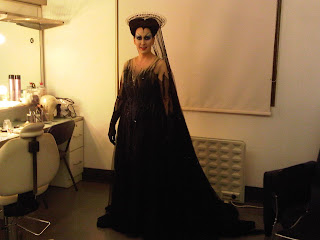
Wig on. Dressers come in to lace me into several layers of sparkly black taffeta and escort me to the stage. Get into position behind wall that is about to fly out, listening to Tamino sing his aria...so far, so normal...except for my heart thudding so loud I worry I won’t be able to hear the orchestra. Tell myself just to focus on blocking, words, oh and not letting giant crescent moon hit me on the head as I cross downstage...
20:42 Husband: Fabulous, darling. X
Aria #1 done and dusted. Time now to rehearse dialogue and review text for Aria #2. Pamina comes into my dressing room to go over dialogue (my version is severely cut down from what she is used to, but she is cool about it). I try not to let the fact that she is a major international name freak me out too much. She’s even more gorgeous close up.
21:43 ROH Repetiteur and Coach: Well done, Laure. You did fabulously. Your voice carried full and true. X
Done with Act 2 aria and no one has come back stage to shoot me yet. Must be doing OK. Haven’t even tripped over the dress. Only Finale Quintet left to survive. Lucky there are a few minutes (!) to rehearse it in dressing room. Friendly 3rd Lady comes to stomp through it with me. (This is usually my knitting time.)
22:33 Husband: Superb! Back stage? X
Finished! Did it! Can’t get the glitter off fast enough…curtain calls were fun, even if my applause was probably just for showing up at all…
22:47 to my Husband: Stage door asap
22:47 Husband: Here now
We catch the milk train home. I’m still covered in glitter, wig glue, and sweat. So that’s what ‘einspringen’ means. Can’t quite get my head around it yet, but I do believe I have just made my debut in a Major International House…completely and utterly by surprise.

Friday, 7 January 2011
In My Own Shoes
Not having to ‘fill another woman's shoes’ transformed my interpretation of a very familiar role.
This season I performed the role of Queen of Night for Welsh National Opera's production of The Magic Flute. It was the second time I appeared in that production (and I've lost track of how many other productions I've done of this particular opera…), but this time it was different. It felt like I made this role my own in a way I hadn't previously, and I largely attribute that transformation to one thing: I got to wear my own shoes. Of course, I must give credit to the marvellously empowering direction of Benjamin Davis, and the inevitable effect of my own increased maturity and experience (ahem). Still, there was something particularly freeing about the shoes. Not just because they were more comfortable than the costume shoes (they were) and enabled me to move more naturally, but also, as I only realised after the production was finished and the shoes were returned to me for everyday use, because of the symbolism. I wasn't being asked to fill another woman's shoes: these are my shoes. This is my role.
You see, in this production, I was originally the understudy, and then offered the role in my own right when the production was revived in 2008, and again this season. So the imprint of being a replacement for someone else remained, along with the costumes, sets, choreography, and shoes. And one day in rehearsal, our lovely director Ben said: 'Laure, why are you walking like that? Are those shoes uncomfortable? Can we get her some different shoes? …What about the ones you usually wear?'
And so I got to be in my own shoes. And I felt more able to sing this role the way I wanted to. And I wondered why I hadn't done this sooner. Perhaps I was still ‘filling someone else's shoes’...and I didn't feel I had the right to complain, or change anything? Ouch.
All this because of some shoes? Well, symbols and metaphors are powerful. And this was the Magic Flute, by they way. Symbolism abounds. Yes, it’s a metaphor, but an important one. One that I will carry with me into my future work and that I recommend to all, whatever your profession or position: be in your own shoes, and comfortable in your own role. Don’t try to be someone else: their shoes won’t fit quite so well.


This season I performed the role of Queen of Night for Welsh National Opera's production of The Magic Flute. It was the second time I appeared in that production (and I've lost track of how many other productions I've done of this particular opera…), but this time it was different. It felt like I made this role my own in a way I hadn't previously, and I largely attribute that transformation to one thing: I got to wear my own shoes. Of course, I must give credit to the marvellously empowering direction of Benjamin Davis, and the inevitable effect of my own increased maturity and experience (ahem). Still, there was something particularly freeing about the shoes. Not just because they were more comfortable than the costume shoes (they were) and enabled me to move more naturally, but also, as I only realised after the production was finished and the shoes were returned to me for everyday use, because of the symbolism. I wasn't being asked to fill another woman's shoes: these are my shoes. This is my role.
You see, in this production, I was originally the understudy, and then offered the role in my own right when the production was revived in 2008, and again this season. So the imprint of being a replacement for someone else remained, along with the costumes, sets, choreography, and shoes. And one day in rehearsal, our lovely director Ben said: 'Laure, why are you walking like that? Are those shoes uncomfortable? Can we get her some different shoes? …What about the ones you usually wear?'
And so I got to be in my own shoes. And I felt more able to sing this role the way I wanted to. And I wondered why I hadn't done this sooner. Perhaps I was still ‘filling someone else's shoes’...and I didn't feel I had the right to complain, or change anything? Ouch.
All this because of some shoes? Well, symbols and metaphors are powerful. And this was the Magic Flute, by they way. Symbolism abounds. Yes, it’s a metaphor, but an important one. One that I will carry with me into my future work and that I recommend to all, whatever your profession or position: be in your own shoes, and comfortable in your own role. Don’t try to be someone else: their shoes won’t fit quite so well.


Subscribe to:
Posts (Atom)